What Is the Betfair Exchange? A Beginner's Guide (Australia)
What is the Betfair Exchange? A plain-English guide to back and lay bets, commission and how it differs from a bookmaker, plus how I use my ratings alongside it.
If you've ever wondered what the Betfair Exchange is and how it differs from a normal bookmaker, you're in the right place. It's one of the most misunderstood corners of Australian betting, and it's worth understanding even if you never open an account.
In this guide I'll explain how it works, what back and lay bets are, how commission is charged, and how I use my ratings to look for runners to back and runners to lay. For Betfair's own explainers, see their exchange basics page and this beginner guide.
What is the Betfair Exchange?
The Betfair Exchange is a betting marketplace where punters bet against each other rather than against a bookmaker. Think of it like a share market for race outcomes. Someone offers a price, someone else takes it, and Betfair matches the two.
Betfair doesn't set the prices. The punters do. That's the key difference, and everything else flows from it.
Back bets and lay bets
On the exchange there are two sides to every bet.
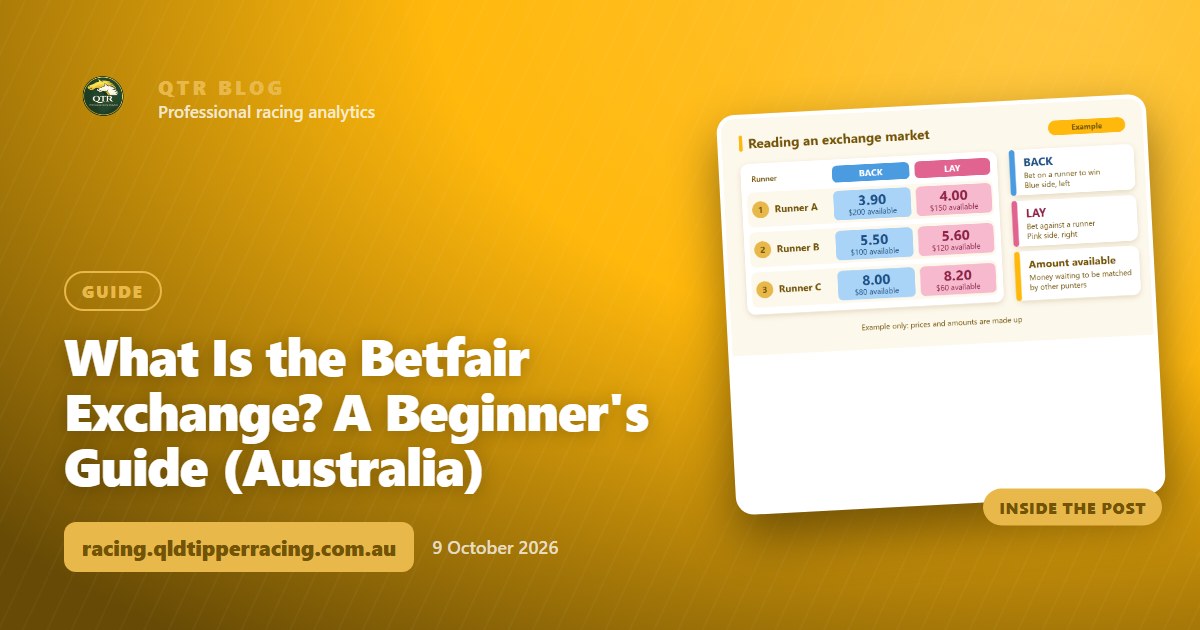
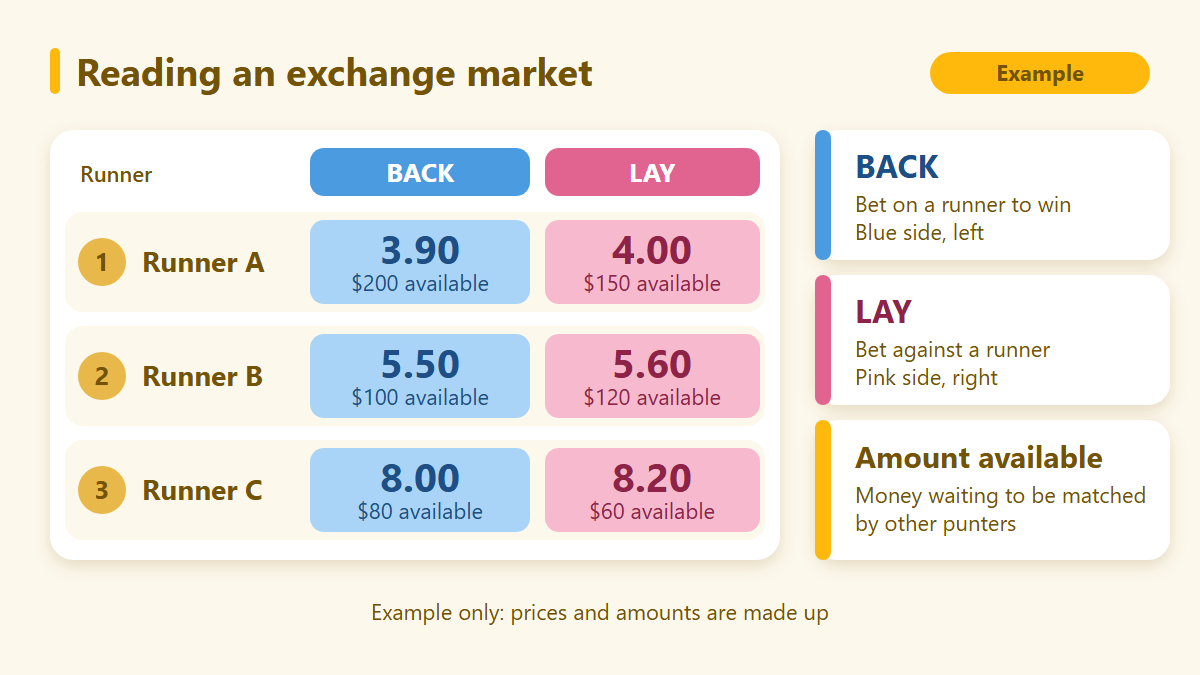
- Back bet: you bet on a horse to win. It's the bet you already know from a bookmaker or the TAB.
- Lay bet: you bet against a horse. You're acting like the bookmaker, taking someone else's back bet, and you win if the horse loses.
Every runner shows a column of back prices (what you can take right now) and a column of lay prices (what you can offer or take). The gap between the best back price and the best lay price is the spread. A tight spread usually means plenty of money in the market.
New to QTR? Sign up free and get 7 days of full access: my ratings, speed maps and race summaries for every race. No card needed.
Sign up freeHow it differs from a standard bookmaker
With a bookmaker, you take the price on offer and they carry the risk. With the exchange, you can take the price that's there or name your own and wait for someone to match it.
The main differences are:
- Who you bet against: other punters, not the house.
- Back and lay: a bookmaker only lets you back. The exchange lets you do both.
- How you're charged: the margin is not built into the price. Betfair takes commission on your winnings instead.
- Price control: you can ask for a price and wait for it, which a fixed-odds bookmaker doesn't offer.
The flip side is that prices only exist if someone is willing to take the other side. On quiet or minor races, the money available can be thin.
Do bookmakers use Betfair to lay off risk?
I hear this question a lot. Laying off risk is a normal part of how bookmakers manage a book, and an exchange is one place where a layer could in theory do it. But I can't tell you which bookmakers do it, how much, or when, and I won't guess.
What I can say is that exchange prices are a useful read on what a lot of punters are willing to bet and lay. That's why people watch them closely.
What is commission?
Betfair charges commission on your net winnings in a market. If you lose, you pay no commission. The rate depends on your account, so check Betfair's own site for the figure that applies to you.
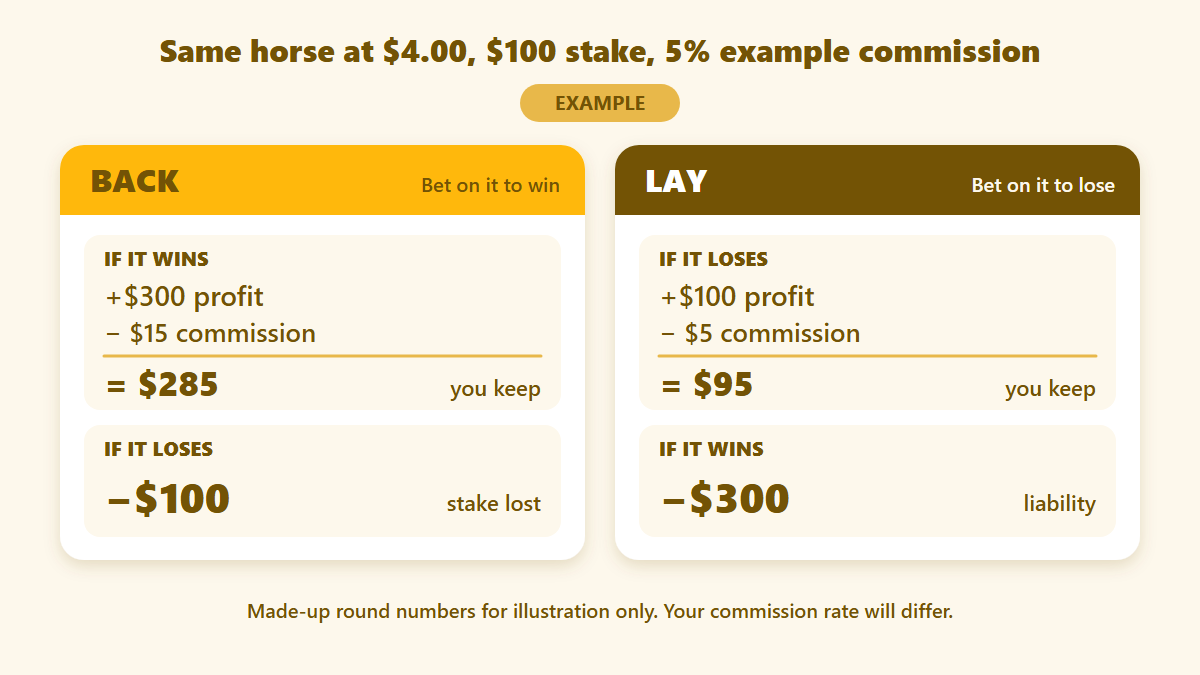
Here's a worked example. The numbers are made up and round, and the 5% commission is an example only, not your actual rate.
Back bet: you back a horse at $4.00 for $100.
- If it wins, you collect $300 profit. At 5% commission you pay $15, so you keep $285.
- If it loses, you lose your $100.
Lay bet: you lay the same horse at $4.00 for $100.
- If it loses, you win the $100 backer's stake. At 5% commission you pay $5, so you keep $95.
- If it wins, you pay out $300. That's your liability.
The liability is the part new punters miss. Laying a $4.00 chance for $100 risks $300 to win $100. Laying a longshot at $20.00 for $100 risks $1,900. Always know your liability before you hit the button.
It's not just racing
The exchange isn't only for horses. Betfair also runs markets on other sports and a range of special events. The back and lay idea works the same way in each.
For this article I'm sticking to racing, because that's what I rate and what I know best.
How the exchange can help when dutching
Dutching means backing more than one runner in a race so you collect the same return whichever one wins. The maths needs prices you can rely on. Being able to name your price on the exchange, rather than just accepting the fixed price, gives you more control over how the stakes line up.
Here's an example. The prices and stakes are made up for illustration. You like two runners, one at $3.00 and one at $6.00.
- Stake $60 on the $3.00 runner: returns $180.
- Stake $30 on the $6.00 runner: returns $180.
- Total outlay is $90, so either winner returns $180, a $90 profit.
- If neither wins, you lose the $90.
The stake split is worked out so the returns match. Commission on the exchange changes the maths slightly, so allow for it. Dutching also doesn't make a bad bet good. The runners still need to be value.
How I use my ratings with the exchange
My ratings give each runner a price I think is fair, which I call the rated price. The idea is simple: compare that to the price in the market.
Finding runners to back
If my rated price is shorter than the market price, the market may be underrating the horse. That's a potential back. For example, if my rated price is $4.00 and the market is paying $5.00, I'd take a closer look. It's not a guarantee. It just tells me where to start looking.
Finding false favourites to lay
A false favourite is a horse the market has short, but my ratings say it shouldn't be. If my rated price is $6.00 and the market has it at $3.00, the market is paying me to oppose it. That's the kind of runner I'd consider laying.
Laying carries real risk, since the liability is bigger than the stake. A false favourite can still win. You're playing the odds over time, not predicting one race.
Where QTR helps
QTR doesn't place bets for you. It gives me the information I use to decide whether a price is worth taking. These are the parts I lean on:
- Rated vs current prices: the race card shows my rated price next to the current market price, with TAB prices included for ratings, odds and price movement.
- Odds comparison: I can compare bookmaker prices, now including Bet365.
- Live price movement and market movement: both are on the race page, so I can see where money is coming or going.
- Hover explanations: column headers on the race card explain themselves when you hover over them.
- My Bets and closing price (CLV): I can track my bets and see whether I beat the closing price, which is one of the better checks on whether I'm finding value.
You can browse the race cards any time, and see what's included at each level on the membership page. If you like the long game, the free Futures page covers the longer-range markets too.
More strategies to come
The exchange opens up a few other approaches that deserve their own guides. I'll cover these in future articles:
- Matched betting: using back and lay bets together to lock in a result.
- Turning over bonus bets: how bookmaker offers can be played through, and the terms to watch.
- Lay betting: a closer look at opposing favourites and managing liability.
Keep an eye on the blog for those.
Ready to try it?
The best way to see how my ratings compare to the market is to look at a real race card. Start the 7-day free trial and compare my rated prices to the market on your next meeting.
Frequently asked questions
What is the Betfair Exchange in simple terms?
It's a betting marketplace where punters bet against each other rather than a bookmaker. You can back a horse to win or lay it to lose, and Betfair matches the two sides.
What is the difference between a back bet and a lay bet?
A back bet is a bet on a horse to win. A lay bet is a bet against it, so you win if it loses, but your liability is larger than your stake if it wins.
How does Betfair commission work?
Betfair charges commission on your net winnings in a market, and nothing if you lose. The rate depends on your account, so check Betfair for the figure that applies to you.
How is the Betfair Exchange different to a bookmaker?
A bookmaker sets the price and carries the risk. On the exchange the punters set the prices, you can back or lay, and Betfair earns commission rather than building a margin into the odds.
What is a false favourite?
It's a runner the market has short in the betting that my ratings say shouldn't be. Some punters consider laying these, but the liability is real and they can still win.
Get 7 days of full access, free
Sign up free and every feature is unlocked for your first 7 days. No card needed.
- My ratings, speed maps and race summaries for every race
- Ratings Lab, My Assessment and custom speed maps
- QTR Futures for the big races ahead
- Form tools, head to head, trainer patterns and the Statistics tab
Read next
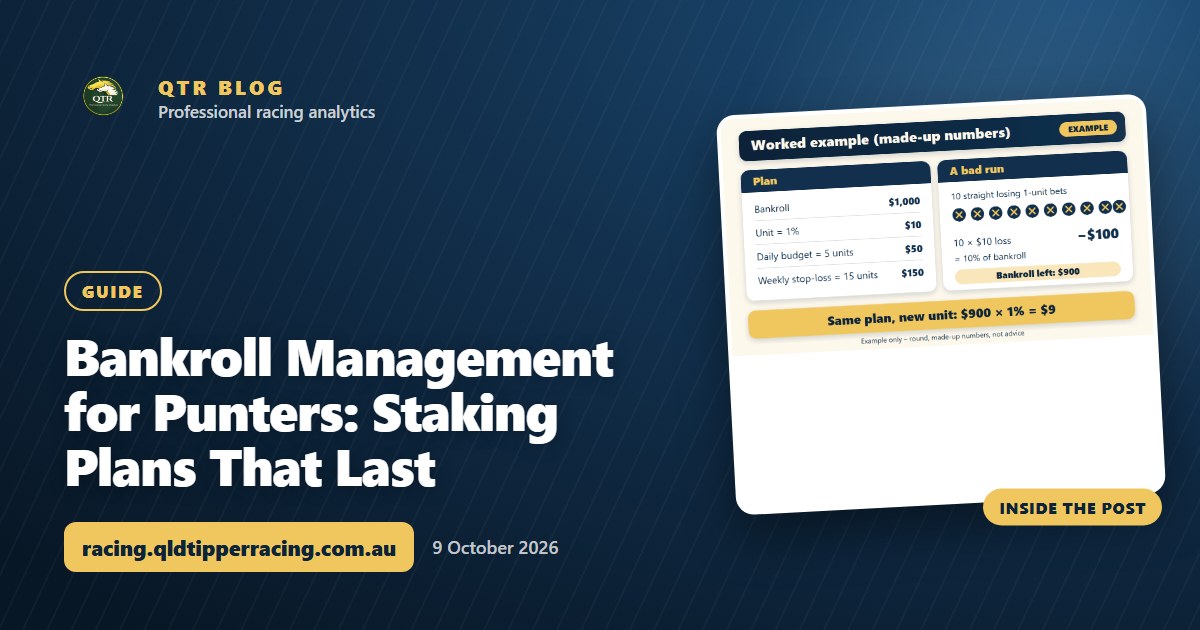 GuideBankroll Management for Punters: Staking Plans That LastBankroll management is what keeps you punting through the losing runs. Here's how I think about bankrolls, units, daily budgets and when to scale up or down.
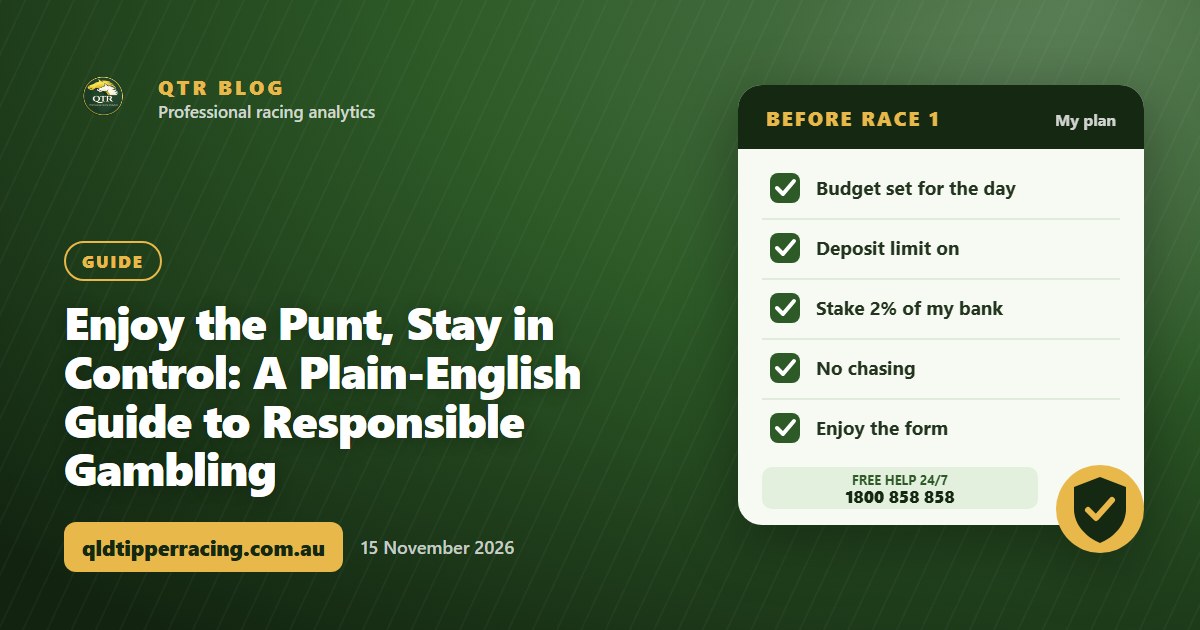 GuideEnjoy the Punt, Stay in Control: A Plain-English Guide to Responsible GamblingMost people enjoy a punt. Here's what staying in control actually looks like, the tools already there for you, and the free help available any time.
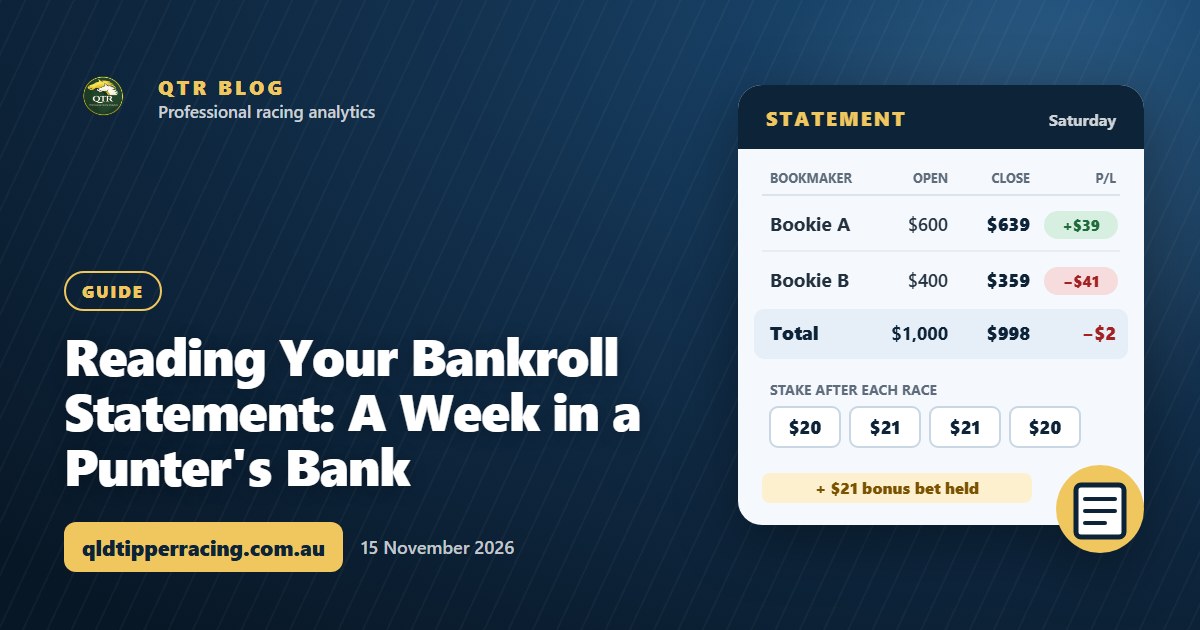 GuideReading Your Bankroll Statement: A Week in a Punter's BankOne made-up week of 2% staking across two bookmakers, followed line by line: how the stake moves after each race, bonus bets, withdrawals and when to change your percentage.