Bankroll Management for Punters: Staking Plans That Last
Bankroll management is what keeps you punting through the losing runs. Here's how I think about bankrolls, units, daily budgets and when to scale up or down.
Bankroll management for punters is the least exciting part of racing and the part that decides whether you're still playing next autumn. You can find good bets and still go broke if you stake them badly. You can also be a middling picker and last for years if your staking is sound.
This guide is useful whether or not you ever join QTR. I'll cover the idea first, then a worked example, then how I use my own tools to stick to the plan.
Bankroll Basics: the series
- Bankroll management for punters: staking plans that last (you're reading it)
- Horse racing bet tracker: track your bets and ROI
- My Bankroll: your bank, every bookmaker, one page
- Bonus bets explained: what they're worth and how to track them
- Why bookmakers give bonus bets, and why they take them away
- Turning bonus bets into cash: matched betting explained
- Reading your bankroll statement: a week in a punter's bank
- Enjoy the punt, stay in control
What is a bankroll?
Your bankroll is the pot of money set aside purely for betting. It is not your rent, your bills or next month's grocery money. It's an amount you've decided in advance you can afford to lose without it hurting your life.
Keeping it separate matters. If your betting money sits in the same account as everything else, every bet quietly becomes a bet with your whole pay. A dedicated bankroll, ideally in its own account, gives you a clear number to protect and a clear signal when things are going wrong.
What are units?
A unit is your standard bet size, expressed as a slice of your bankroll. Most disciplined punters use somewhere between 1% and 2% of the bankroll per unit. That's a common rule of thumb, not a law, and smaller is fine.
Thinking in units does two things:
- It stops you staking by feel. A bet is 1 unit, or half a unit, not whatever seems right after a couple of beers.
- It makes results comparable. Up 20 units means something whether your unit is $5 or $50.
The reason the percentage is small is variance. Racing is full of losing runs, even for people who find real value. If a punter's picks win 1 in 5 and each bet is independent, a run of 10 straight losers will turn up about 11% of the time. At 1 in 4 it's still around 6%. Your staking has to survive that without you panicking.
New to QTR? Sign up free and get 7 days of full access: my ratings, speed maps and race summaries for every race. No card needed.
Sign up freeSet a plan before the first race
A plan written down on a quiet Tuesday beats a decision made at 4:40pm on Saturday with a few races to go. Mine has four parts:
- Bankroll: the total amount set aside.
- Unit size: a fixed percentage of that bankroll, such as 1%.
- Daily budget: the most I'll risk on a given day, such as 5 units.
- Stop rule: what makes me finish for the day, and what makes me pause for the week.
The daily budget is the one most people skip. Without it, a bad day has no floor. With it, the worst realistic outcome is known before you place a bet.
Look for value, then stake it consistently
Staking only protects you. It doesn't create an edge. The edge comes from value: backing a horse at a price bigger than its real chance of winning.
If my ratings make a horse a $4.00 chance (a 25% winner) and the market offers $5.00, that's value. If the market is $3.50, it isn't, even if I like the horse. Value is a price question, not an opinion about the horse.
I keep the stake the same for each bet at roughly the same level of confidence. Raising the stake because a horse feels like a good thing is how a small leak becomes a flood. Feelings are the least reliable input you have.
A worked example
Here's a simple example with made-up round numbers, so you can see how the pieces fit together.
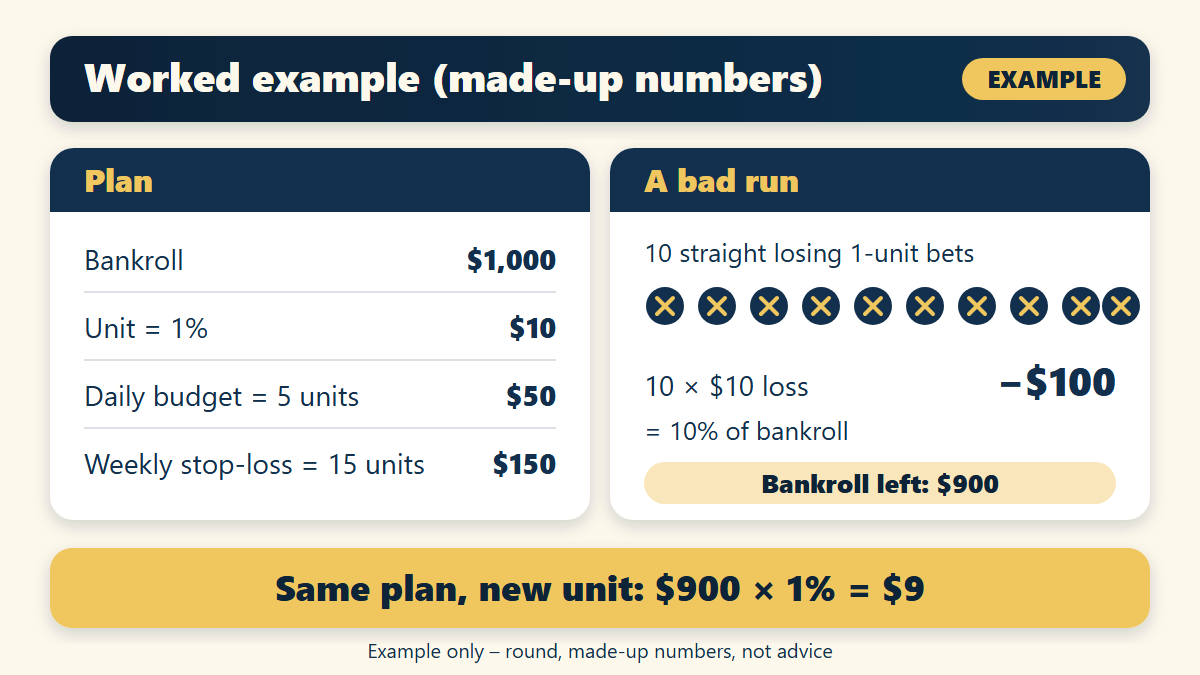
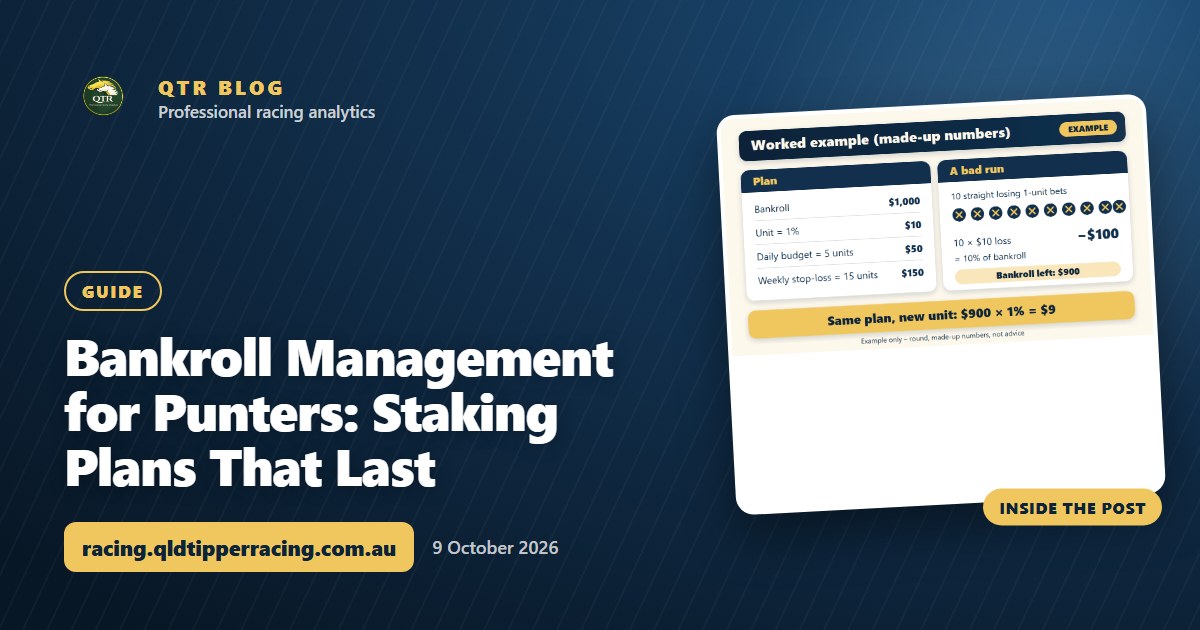
Say I start with a $1,000 bankroll and a 1% unit, so each bet is $10. My daily budget is 5 units, or $50. That means on my worst possible day I lose $50, which is 5% of the bankroll.
Now suppose I hit that ten-race losing run. At $10 a bet I'm down $100 and the bankroll is $900. It stings, but I'm still comfortably in the game and the next unit is simply $9.
Compare that with a punter who bets $100 a race on the same $1,000. The same run wipes them out. Same picks, same luck, completely different outcome, and the only difference is staking.
When to scale up or down
Don't change your unit after every result. I review on a fixed schedule, such as monthly, and recalculate the unit as a percentage of the current bankroll.
- Bankroll grows: the unit rises with it. $1,200 at 1% is a $12 unit.
- Bankroll shrinks: the unit falls. $800 at 1% is an $8 unit.
Scaling down in a bad patch feels like giving up, but it's the point of the system. Smaller bets stretch your bankroll across the variance until results settle. Scaling up with a growing bankroll is the same rule working the other way. It's not a reason to jump to 5 units because you're hot.
Be disciplined and don't chase your losses
Chasing is the classic way bankrolls die. You lose the first, so you double up on the second to get square, lose again, and by the last race you're betting a month of profit on a horse you hadn't looked at.
The maths doesn't care that you're down. Each race is a fresh bet at a fresh price. If the next bet isn't value at your normal stake, it isn't value at three times your stake either.
A few habits that help:
- Write the day's bets down before the first race.
- Never raise the stake to win back a loss.
- Don't add extra bets in the last few races just to have a bet.
- If you break the plan, note it and go back to it the next day.
Know when to call it a day
Hitting your daily budget is the finish line, not a challenge. I stop when the budget is gone, and I stop if I notice I'm angry, bored or betting to feel something. Those are bad moments to make decisions.
A weekly stop is useful too. If I lose my weekly limit, I step back, review the bets, and come back with a clear head rather than a bigger stake.
Don't be afraid of missing a bet
There will always be a winner you didn't back. A $15 shot salutes at a meeting you skipped, or a horse you passed on at a short price wins by five lengths. That's racing.
The goal isn't to catch everything. It's to bet only when the price is right, at a stake you can live with, and still have a bankroll next month. Passing on a race is a decision, and often the best one.
Bet responsibly
Betting money should be money you can genuinely afford to lose, and betting isn't a way to pay bills or clear debts. Most bookmakers let you set deposit limits, which is a sensible backstop for the plan you've already written. If it stops being fun, step away and talk to someone.
How QTR helps you stick to the plan
Staking only works if you know your numbers, so a lot of what I've built is about keeping honest records and finding value.
- My Bets tracking: log your bets and see your results, with place and each way bets graded properly. You can see whether your staking plan is doing its job rather than guessing.
- Closing price (CLV) on My Bets: shows whether you're regularly beating the final market price, which is a useful check on whether you're really finding value.
- Bet Tracker dashboard and Results page: filters and a chart make it easier to spot patterns in your results over time.
- Odds comparison, now including Bet365, and TAB prices: helps you find the best available price, because the gap between a rated price and the market is where value lives.
- Price movement on the race page: shows how the market is shifting before you commit.
- CSV exports: download your history if you want to run your own staking numbers.
- My Bankroll: your whole bank in one place across every bookmaker, with the stake for each race worked out from your percentage and a daily statement per bookmaker. It's this plan, built into a page. See My Bankroll.
You can see what's included at /unlock, browse today's race cards, or check recent updates in the changelog. More guides are on the blog.
Ready to try it?
The best staking plan is the one you actually follow, and tracking your bets is the easiest way to stay honest. You can try everything with the 7-day free trial, log your first bets, and see how your plan holds up.
Next in the series: horse racing bet tracker, and why keeping score changes how you punt.
Frequently asked questions
What is a bankroll in horse racing betting?
It's the amount of money you've set aside purely for betting, separate from bills and living costs. It should be an amount you can afford to lose.
How much of my bankroll should I bet on each race?
Many disciplined punters use 1% to 2% of their bankroll as a standard unit. Smaller is fine, and the key is keeping the stake consistent rather than betting on feel.
What is a unit in betting?
A unit is your standard bet size, set as a percentage of your bankroll. With a $1,000 bankroll and a 1% unit, one unit is $10.
How do I stop chasing losses?
Set a daily budget and stop rule before you start, and finish when the budget is gone. Never raise your stake to win back a loss, because each race is a fresh bet at its own price.
When should I increase or decrease my unit size?
Review on a fixed schedule, such as monthly, and recalculate the unit as a percentage of your current bankroll. It rises as the bankroll grows and falls when it shrinks.
Get 7 days of full access, free
Sign up free and every feature is unlocked for your first 7 days. No card needed.
- My ratings, speed maps and race summaries for every race
- Ratings Lab, My Assessment and custom speed maps
- QTR Futures for the big races ahead
- Form tools, head to head, trainer patterns and the Statistics tab
Read next
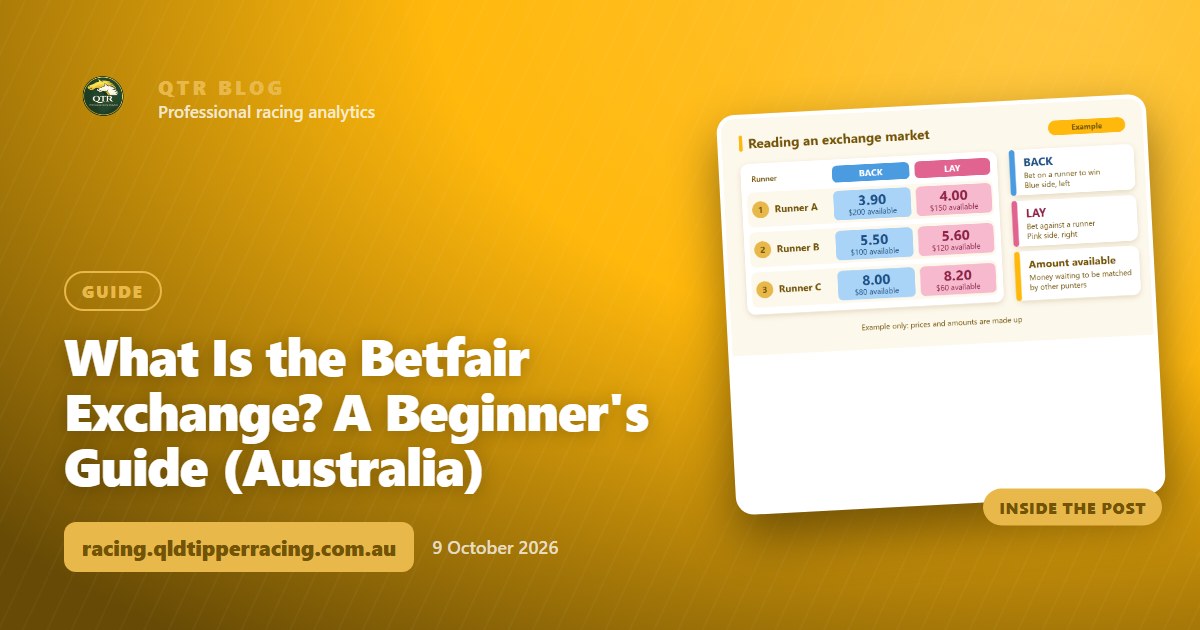 GuideWhat Is the Betfair Exchange? A Beginner's Guide (Australia)What is the Betfair Exchange? A plain-English guide to back and lay bets, commission and how it differs from a bookmaker, plus how I use my ratings alongside it.
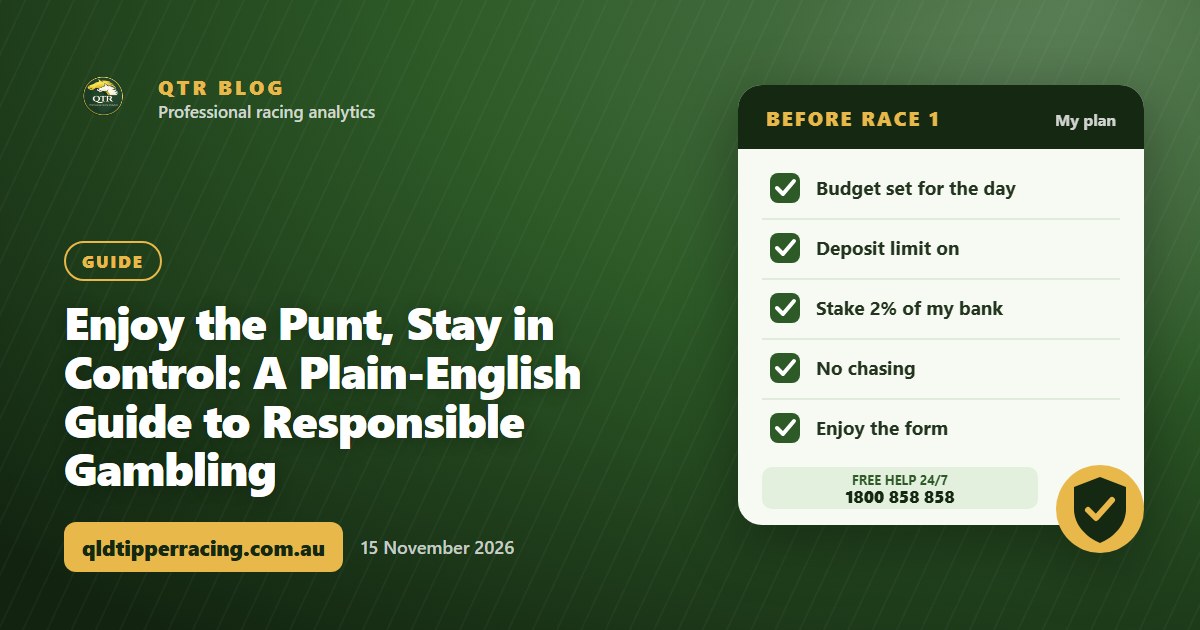 GuideEnjoy the Punt, Stay in Control: A Plain-English Guide to Responsible GamblingMost people enjoy a punt. Here's what staying in control actually looks like, the tools already there for you, and the free help available any time.
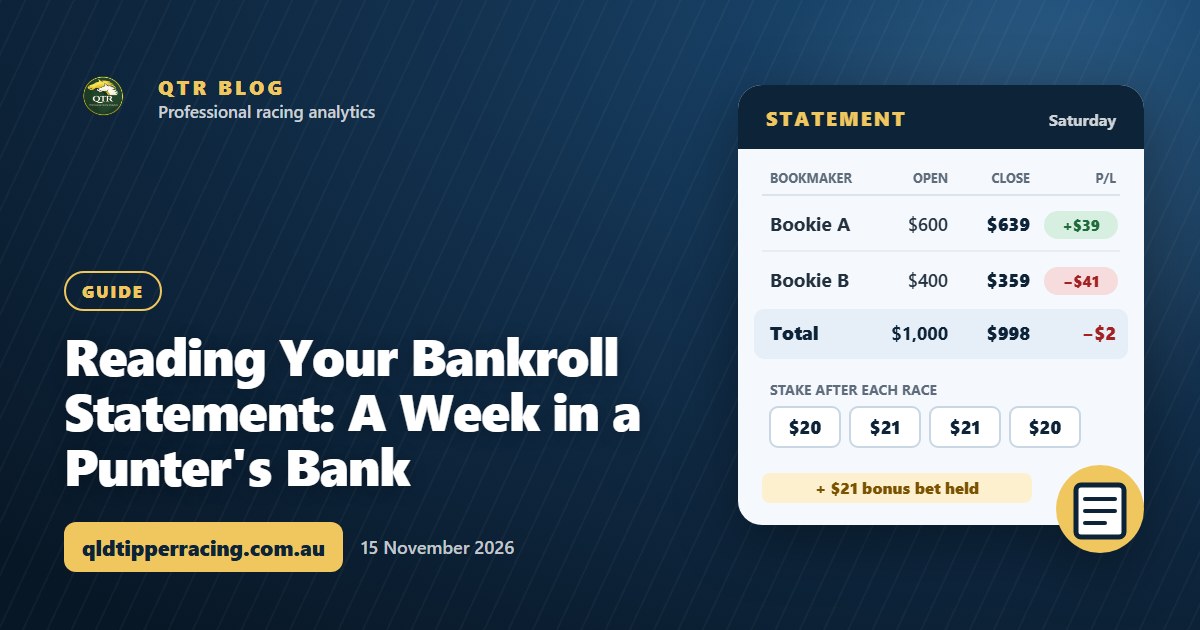 GuideReading Your Bankroll Statement: A Week in a Punter's BankOne made-up week of 2% staking across two bookmakers, followed line by line: how the stake moves after each race, bonus bets, withdrawals and when to change your percentage.