How to Find Value Bets in Horse Racing Using Rated Prices
A plain-English guide to comparing a rated price with the market price, spotting overlays and avoiding the traps. Includes a worked example with round numbers.
If you want to find value bets in horse racing, the most useful habit I can teach you is to stop asking "who will win?" and start asking "is the price right?". A horse can be the most likely winner of the race and still be a bad bet. Another can be a 15% chance and a very good bet.
The tool that makes this practical is the rated price. This guide explains what it is, how to use it, and where people go wrong. You can use all of it with a pen and paper, whether or not you ever join QTR.
What is a rated price?
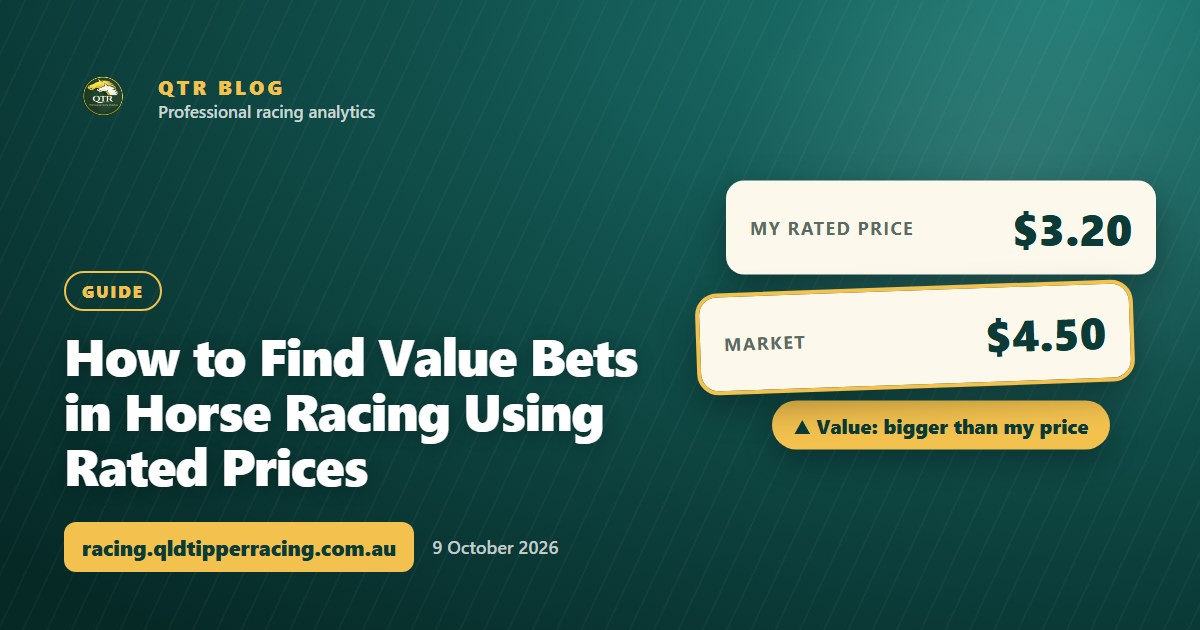
A rated price is my own estimate of what a horse should be priced at, based on its chance of winning. If I think a horse wins one time in four, its rated price is $4.00. It is a probability expressed in the same language as the bookmakers' odds.
That is the whole point. Once my view and the market's view are both in dollars, I can put them side by side and see where they disagree.
- Rated price: what I think the horse should be.
- Market price: what you can actually get from a bookmaker or the tote.
- Value: when the market price is meaningfully bigger than the rated price.
The value idea in one paragraph
Every price carries an implied chance. Divide 1 by the price and you have it: $2.00 is 50%, $4.00 is 25%, $10.00 is 10%. If the market is offering a bigger price than my rated price, the market is underrating the horse compared with me. That gap is called an overlay.
If the market price is shorter than my rated price, it is an underlay. I don't want to be there, however good the horse looks.
New to QTR? Sign up free and get 7 days of full access: my ratings, speed maps and race summaries for every race. No card needed.
Sign up freeA worked example
These are made-up round numbers for illustration only. They are not a real race or a real tip.
Say I rate Horse A at $4.00. That is a 25% chance of winning. The market is offering $5.00, which implies only a 20% chance.
Here is what that is worth over the long run:
- Win 25% of the time and collect $5.00 for every $1 staked.
- Expected return per $1 is 0.25 × 5.00 = $1.25.
- Expected profit is $0.25 per $1, or about 25%.
On a $100 stake, I expect to get back about $125 on average. But on any single bet, Horse A loses three times out of four. Value does not mean it wins. It means that if my rated price is accurate and I keep taking prices like this, the maths works in my favour over time.
Now flip it. Say I rate Horse B at $6.00, about a 16.7% chance, and the market has it at $5.00.
- Expected return per $1 is 0.167 × 5.00 = about $0.83.
- That is a loss of roughly 17 cents per dollar, on average.
Horse B might be a lovely horse with a great chance. At $5.00 it is still the wrong side of the price.
A quick way to measure the gap
Divide the market price by the rated price. For Horse A that is 5.00 ÷ 4.00 = 1.25, so a 25% overlay. For Horse B it is 5.00 ÷ 6.00 = 0.83, so a 17% underlay.
Anything above 1.00 is an overlay. How far above you demand is up to you, and that is the next point.
How big an overlay do you need?
No rated price is perfect. If I rate a horse at $4.00 and the market says $4.10, that is a 2.5% overlay, which is well inside the margin of error of any set of ratings. I would not bet it.
I prefer a clear buffer before I act. Many punters set a minimum, such as 10% or 15%, and only bet once the market clears it. A bigger buffer means fewer bets, but each one has more room for my ratings to be a little off and still come out ahead.
There are no guarantees here. A margin protects you from small errors, not from being wrong.
Find value bets in horse racing: a simple process
- Get the rated price for every runner in the race, not just the ones you like.
- Get a real market price you can actually bet at, and compare across bookmakers if you can.
- Work out the overlay by dividing the market price by the rated price.
- Apply your minimum margin and discard everything under it.
- Check the late news: scratchings, track changes, gear changes and late market moves.
- Stake consistently, with a flat stake or a small fixed percentage of your bank.
- Record everything so you can judge the results honestly later.
Step 5 matters. A rated price is only as good as the information behind it. If something changes after the ratings are set, the price may no longer mean what it did.
Common traps
- Chasing longshots. Big overlays on long prices are the most tempting and the least reliable. A small error in the rated price swings the percentage enormously at $31.
- Fake overlays. A price from a bookmaker you can't actually bet with, or a stale price, is not value.
- Ignoring the margin. The market's implied chances add up to more than 100% because of the bookmaker's margin. Your rated chances should add up to 100%.
- Judging on a handful of bets. Ten losers in a row at $5.00 is normal. Value shows up over hundreds of bets, not a weekend.
- Moving the goalposts. If you change your rated price after seeing the market, you are no longer comparing two independent views.
How QTR helps with this
Everything above can be done by hand, but it is slow. Here is how I've built QTR to take out the busywork.
Rated prices next to the market
On each race card, my rated prices sit beside current market prices, so the comparison is already there. I use TAB prices for ratings, odds and price movement, and the odds comparison includes Bet365 alongside other bookmakers. If a column header isn't clear, hovering over it gives an explanation. You can browse the race cards for each meeting to see the layout.
I also fixed a problem where inflated Current prices were coming through from unlisted bookmakers. A fake overlay is the last thing you want, so I'd rather the numbers be boring and right.
Watching the price move
The race page has live price movement and market movement, so you can see whether a price is drifting or firming. A horse that keeps shortening after you've taken the overlay is often a good sign. One that drifts hard deserves a second look at why.
Ratings also freeze at race start, so what you see can't be quietly changed once the race is under way.
Tracking your results and closing price
My Bets tracks your results, and it shows your closing price, often called closing line value (CLV). Beating the closing price consistently is one of the better signs that you are finding genuine value, and it tells you something much faster than win-loss results do. I wrote more about the tools I've added in the what's new log and you can see what each membership level includes on the unlock page.
Futures too
The Futures page is free to view, and there are QTR races for horses on it. The same principle applies: the question is always whether the price on offer is bigger than it should be.
Want to see my ratings on a real race card first? My Demo Playground opens the full members race card for big races like The Everest and the Caulfield Cup, with no sign-in needed.
Ready to try it?
The fastest way to learn value betting is to watch it on live race cards and track your own results. You can start the 7-day free trial and compare my rated prices with the market on your next meeting.
Pick a minimum margin, stake consistently and keep records. The rest is patience.
Frequently asked questions
What is a value bet in horse racing?
A value bet is one where the price on offer is bigger than the horse's real chance of winning justifies. It does not mean the horse is likely to win, only that the odds are better than they should be.
How do you calculate value in horse racing?
Divide the market price by your rated price. A result above 1.00 is an overlay. For example, a market price of $5.00 against a rated price of $4.00 gives 1.25, which is a 25% overlay.
What is an overlay in horse racing?
An overlay is a horse whose market price is bigger than its rated price. The market is underestimating its chance compared with your assessment, so it is the type of price value bettors look for.
Can you lose money on value bets?
Yes, and you will lose most individual bets on longer-priced horses. Value only works over a large number of bets, and only if your rated prices are reasonably accurate.
What is closing line value?
Closing line value compares the price you took with the final price before the race starts. If you regularly take prices bigger than the closing price, it is a good sign you are finding value.
Get 7 days of full access, free
Sign up free and every feature is unlocked for your first 7 days. No card needed.
- My ratings, speed maps and race summaries for every race
- Ratings Lab, My Assessment and custom speed maps
- QTR Futures for the big races ahead
- Form tools, head to head, trainer patterns and the Statistics tab
Read next
 GuideWhat Is the Betfair Exchange? A Beginner's Guide (Australia)What is the Betfair Exchange? A plain-English guide to back and lay bets, commission and how it differs from a bookmaker, plus how I use my ratings alongside it.
 GuideBankroll Management for Punters: Staking Plans That LastBankroll management is what keeps you punting through the losing runs. Here's how I think about bankrolls, units, daily budgets and when to scale up or down.
 GuideEnjoy the Punt, Stay in Control: A Plain-English Guide to Responsible GamblingMost people enjoy a punt. Here's what staying in control actually looks like, the tools already there for you, and the free help available any time.