Turning Bonus Bets into Cash: Matched Betting with Betfair Explained
How matched betting locks in most of a bonus bet's value whatever the result: a $50 bonus bet to about $40 cash, the lay formula, why price matters and what can go wrong.
If you've read part 4, you know a bonus bet is worth less than its face value. Put a $50 bonus bet on a $2.00 favourite and, over time, it's worth about $25 to you. Put it on a longer price and it keeps more of its value, but most of the time it loses and you get nothing.
There's a way to lock in most of that value whatever happens in the race. It's called matched betting, and it's how a lot of punters turn a $50 bonus bet into around $35 to $40 of real cash. There are plenty of websites, calculators and forums built around it. This post covers the idea in plain terms so you understand what they're doing and what can go wrong.
Bankroll Basics: the series
- Bankroll management for punters: staking plans that last
- Horse racing bet tracker: track your bets and ROI
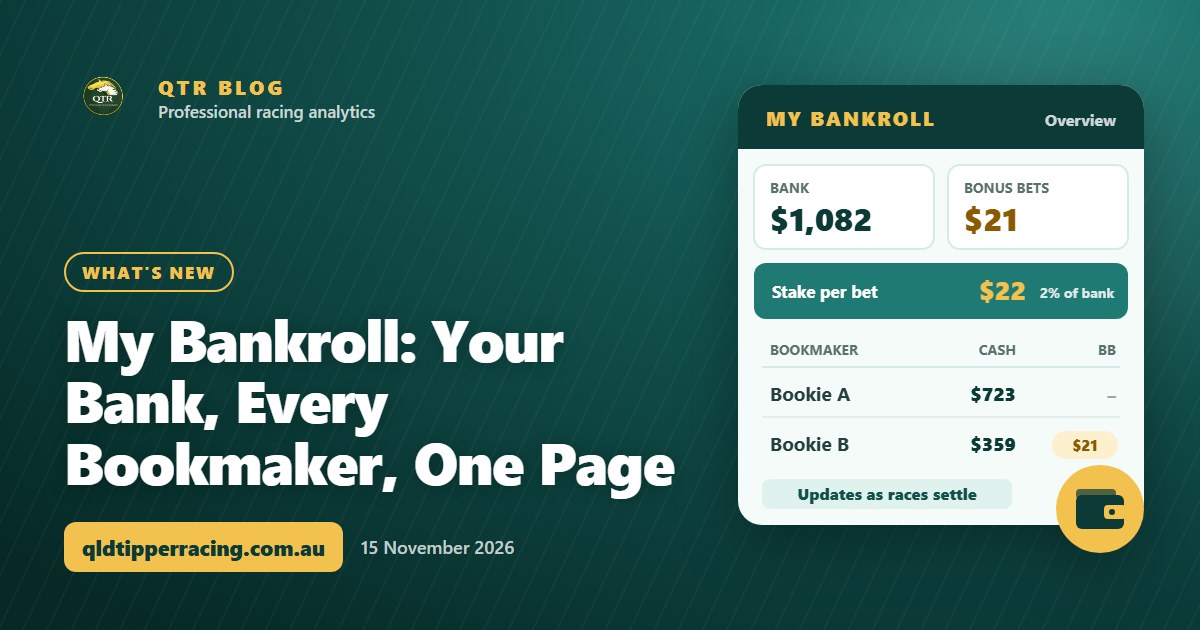
- My Bankroll: your bank, every bookmaker, one page
- Bonus bets explained: what they're worth and how to track them
- Why bookmakers give bonus bets, and why they take them away
- Turning bonus bets into cash: matched betting explained (you're reading it)
- Reading your bankroll statement: a week in a punter's bank
- Enjoy the punt, stay in control
The idea in one sentence
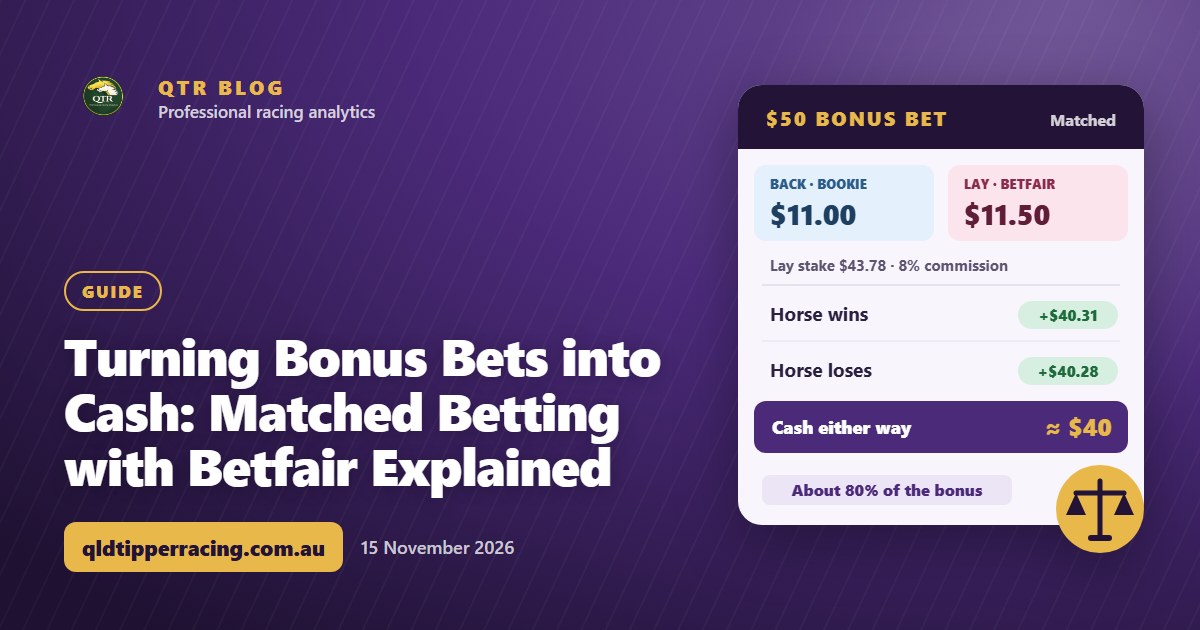
You back a horse with the bonus bet at the bookmaker, and at the same time you lay the same horse on the Betfair exchange, so you win roughly the same amount whether the horse wins or loses.
Laying means betting that a horse will lose. On Betfair you take the bookmaker's side of the bet: if the horse loses, you keep the backer's stake. If it wins, you pay out.
Because you're on both sides, the result of the race stops mattering. What's left is a fixed slice of the bonus bet's value, paid as cash.
A worked example: $50 bonus bet to $40 cash
You have a $50 bonus bet. You find a horse at $11.00 with the bookmaker and $11.50 to lay on Betfair. Commission on that market is 8%.
The lay stake that evens things out is:
Lay stake = bonus bet × (back price − 1) ÷ (lay price − commission)
That's $50 × 10 ÷ (11.50 − 0.08) = $43.78.
| If the horse... | Bookmaker | Betfair | Result |
|---|---|---|---|
| Wins | +$500 (winnings only, stake not returned) | −$459.69 (you pay out the lay) | +$40.31 |
| Loses | $0 (the bonus bet is gone) | +$40.28 (the lay stake, less 8% commission) | +$40.28 |
Either way, about $40 in cash from a $50 bonus bet. That's roughly 80%, which is about as good as it gets.
New to QTR? Sign up free and get 7 days of full access: my ratings, speed maps and race summaries for every race. No card needed.
Sign up freeWhy the price matters so much
The same $50 bonus bet locks in very different amounts depending on the price you use it on:
| Back price | Lay price | Cash locked in | Kept |
|---|---|---|---|
| $3.00 | $3.10 | about $30 | 61% |
| $6.00 | $6.20 | about $38 | 75% |
| $11.00 | $11.50 | about $40 | 80% |
All at 8% commission. The pattern is the same as in part 4: because the stake doesn't come back, longer prices keep more of the bonus bet's value. Most matched betting guides aim for 70% to 80%, and the top end usually needs a price above $5 with a tight gap between the back and lay price.
Two things eat into it:
- The gap between back and lay. The closer the lay price is to the bookmaker's price, the more you keep. A horse at $11 with the bookmaker and $14 on Betfair is a poor match.
- Commission. Betfair charges commission on your winnings in each market. On Australian racing it's between 7% and 10% depending on the state, and it's highest on NSW racing at 10%. Check the market's rules before you lay.
Another approach: overlay and let Betfair do the winning
The standard method above evens out the result, so half the time your profit lands at the bookmaker and half the time on Betfair. Some punters prefer to lean the other way on purpose: lay a bigger stake than the calculator says, so the money mostly ends up on Betfair and the bookmaker mostly sees a losing bet. This is called overlaying.
Take a $50 bonus bet on a $2.00 favourite, laid at $2.10 with 8% commission:
| Lay stake | If the horse wins | If the horse loses | |
|---|---|---|---|
| Standard (balanced) | $24.75 | +$50 bookmaker, −$27.23 Betfair = +$22.77 | +$22.77 Betfair |
| Overlay | $50.00 | +$50 bookmaker, −$55.00 Betfair = −$5.00 | +$46.00 Betfair |
With the overlay, when the favourite loses the bonus bet simply disappears at the bookmaker and $46 lands on Betfair. When it wins, the bookmaker pays you $50, Betfair takes $55, and you're $5 down overall.
Why some punters like it:
- Your bookmaker account looks less like a winner. Your profit builds up on Betfair, not with the bookmaker, which is the opposite of the pattern bookmakers flag (see part 5).
- Betfair doesn't mind winners. It matches you against other punters and earns its commission whoever wins, so a winning customer isn't a cost to it the way it is to a bookmaker.
- Fewer withdrawals from the bookmaker. In my experience, constantly withdrawing straight after a win is frowned on by bookmakers. With an overlay, the money you take out mostly comes from Betfair.
The same idea works on ordinary cash bets on a promo race: back with the bookmaker and lay a little more than the balanced amount on Betfair.
What you give up:
- It's a bet, not a lock. You're backing the horse to lose. In the example that pays $46 or costs $5, and over many goes it averages out slightly below the $22.77 the balanced lay guarantees.
- Bigger liability. You need $55 on Betfair for this lay instead of about $27, and more on longer prices.
- No promises. Bookmakers look at more than your profit, and they can still restrict an account that's mostly promo bets.
Before you try it
Matched betting is maths, but there's real money in play, and most of the horror stories come from small mistakes.
- You need money on Betfair to cover the liability. In the example you're laying at $11.50, so Betfair holds about $460 of your money until the race is run. Longer prices mean bigger liabilities.
- Check there's enough money in the lay market. On a quiet country race there may not be $43 available to lay at $11.50.
- Place both bets close together. Prices move. If you place the bonus bet and wait ten minutes to lay, the lay price might have jumped.
- Double-check the numbers. Laying $437.80 instead of $43.78 is a very expensive typo. Use a calculator and read the bet slip twice.
- Know your bonus bet's rules. Minimum odds, win only, expiry date, and whether it has to be used in one go.
- Scratchings and deductions. If your horse is scratched, both bets are usually void, but deductions on the other runners can affect the bookmaker and the exchange differently.
- Expect attention. As I covered in part 5, bonus bets that always land on long prices with a matching lay are a pattern bookmakers recognise. Matched betting is legal, but a bookmaker can still stop offering you promos. The overlay approach above changes how that looks, though it doesn't make you invisible.
No exchange? Dutching
Some punters use a method called dutching instead: you put the bonus bet on one runner and back the other main chances with cash at other bookmakers, so you get something back whichever wins. It works without Betfair, but it's harder to balance in a big field and usually keeps less of the value. The calculators on matched betting sites handle both methods.
Tracking it in My Bankroll
In My Bankroll:
- Log the bonus bet as a normal bet from the race page with Use bonus bets ticked, so it comes out of that bookmaker's bonus bet balance and the winnings (if any) go into its cash.
- Add Betfair as one of your accounts, and record the lay result as an adjustment on the day: a plus figure if the horse lost, a minus figure if it won.
Add the two together on the Statement and you'll see the cash you locked in. Proper lay bet tracking, and a turnover planner for working through a pile of bonus bets, are next on the list for My Bankroll.
Is it worth it?
For a punter who already collects a few bonus bets a month from normal betting, matched betting is a sensible way to get cash out of them rather than letting them expire or throwing them at short-priced favourites.
As a business plan it's a different story. Promos are limited, accounts get restricted, and the profit per offer is small. It also keeps you around betting sites far more than you'd otherwise be. If you notice it's turning into more betting rather than less, that's worth paying attention to. Part 8 has more on that.
Next in the series: reading your bankroll statement, a week in a punter's bank, line by line.
18+. Decide what you're happy to spend before you start. Free, confidential support any time on 1800 858 858 or at gamblinghelponline.org.au.
Frequently asked questions
What is matched betting?
Backing a horse with a bonus bet at a bookmaker and laying the same horse on the Betfair exchange, so you lock in roughly the same cash whether it wins or loses.
How much of a bonus bet can I turn into cash?
Usually 70% to 80%. In the worked example a $50 bonus bet at $11.00, laid at $11.50 with 8% commission, locks in about $40.
How do I work out the lay stake?
Lay stake = bonus bet × (back price − 1) ÷ (lay price − commission). For a $50 bonus bet at $11.00 laid at $11.50 with 8% commission, that's $43.78.
Why use longer prices?
Because a bonus bet doesn't return the stake, longer prices keep more of its value. At $3.00 you keep about 61%; at $11.00 about 80%, provided the lay price is close.
Is matched betting legal in Australia?
Yes, but bookmakers can still restrict promos on accounts that look like they're only matched betting.
What is overlaying a bonus bet?
Laying more than the balanced amount on Betfair so most of your profit lands on the exchange and the bookmaker mostly sees losing bonus bets. A $50 bonus bet at $2.00 with a $50 lay at $2.10 returns about $46 if the horse loses and costs $5 if it wins. It's a bet, not a locked profit.
Get 7 days of full access, free
Sign up free and every feature is unlocked for your first 7 days. No card needed.
- My ratings, speed maps and race summaries for every race
- Ratings Lab, My Assessment and custom speed maps
- QTR Futures for the big races ahead
- Form tools, head to head, trainer patterns and the Statistics tab
Read next
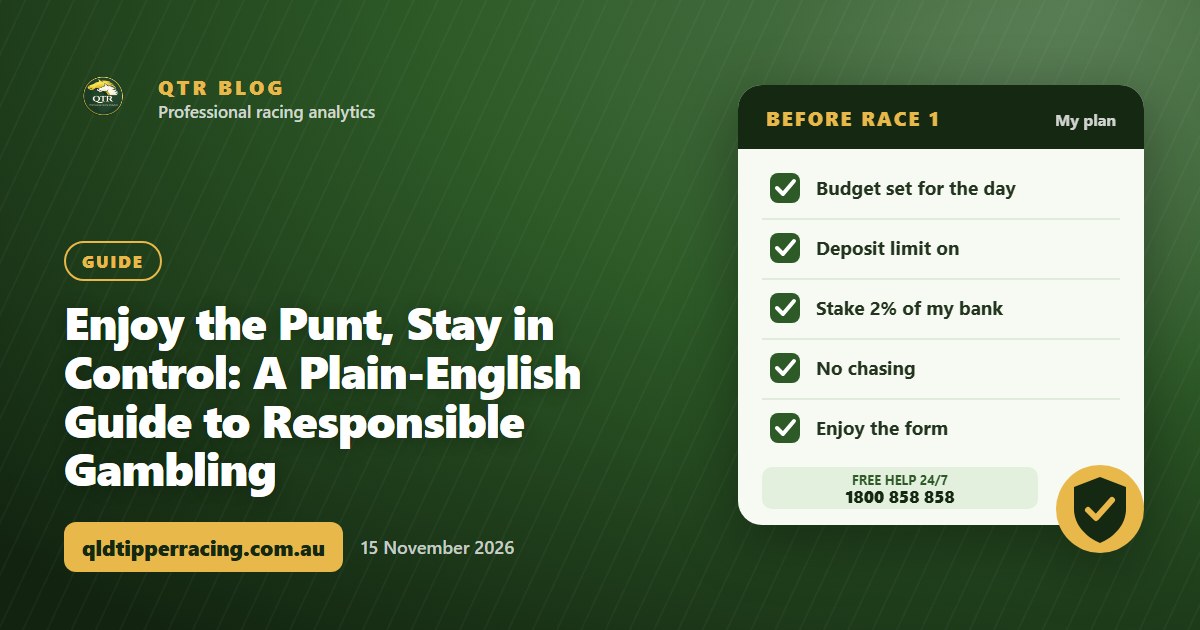 GuideEnjoy the Punt, Stay in Control: A Plain-English Guide to Responsible GamblingMost people enjoy a punt. Here's what staying in control actually looks like, the tools already there for you, and the free help available any time.
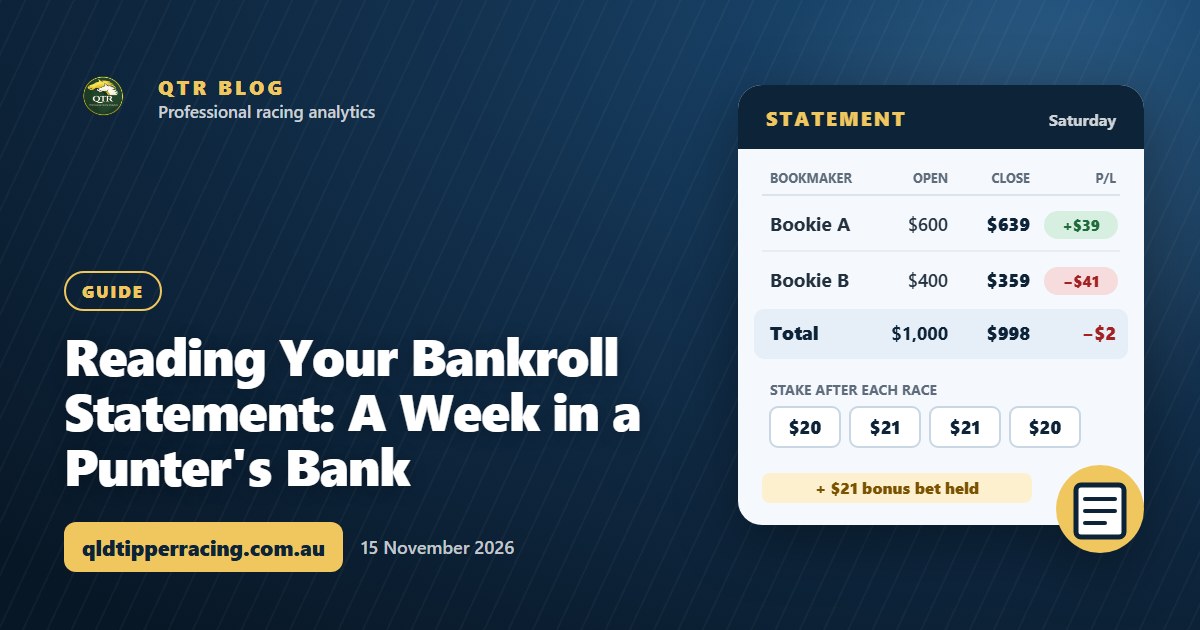 GuideReading Your Bankroll Statement: A Week in a Punter's BankOne made-up week of 2% staking across two bookmakers, followed line by line: how the stake moves after each race, bonus bets, withdrawals and when to change your percentage.
 GuideWhy Bookmakers Give You Bonus Bets (and Why They Take Them Away)Bonus bets are marketing, not a gift. Why bookmakers offer them, why they restrict accounts that only chase promos, which brands share an owner, and how to keep your accounts healthy.